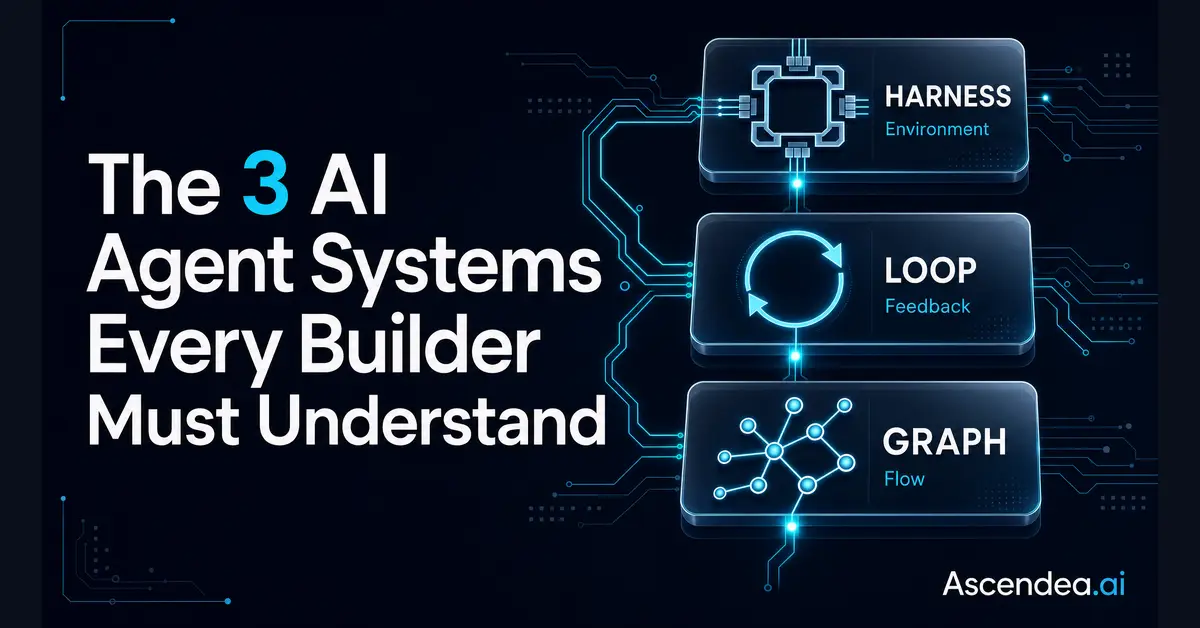
The 3 AI Agent Systems Every Builder Must Understand
By Rob Arnold, CTO, Ascendea AI
The model is rarely the first thing to blame when an AI agent fails. Most failures start in the system around it: missing data, vague tool instructions, forgotten state, uncontrolled retries or a workflow nobody can inspect.
Reliable AI agent systems need three engineering layers. The harness provides the working environment, the loop checks the result, and the graph controls the route. Get those three right before paying for a more expensive model.
Harness = where the agent works. Loop = how it proves the work. Graph = what it may do next.
That distinction matters once an agent can update a CRM, contact a lead, publish content or spend money. A clever demo can improvise. A business system needs boundaries and evidence.
Why AI Agent Systems Need More Than a Good Prompt
A prompt can guide one model response. It cannot keep a customer record available tomorrow, limit access to a database or prove that an email was sent to the correct person.
OpenAI describes agents as systems that complete tasks on a user’s behalf, using a model to manage work and tools to gather information or take action within defined controls.[1] Anthropic makes a useful distinction between fixed workflows and agents that choose their own process and tool use.[2]
For a UK SME, the practical point is simple. If the agent can affect customers, revenue or records, prompt quality is only one part of the design.
| Engineering layer | The question it answers | Typical business controls |
|---|---|---|
| Harness engineering | Where and with what may the agent work? | CRM access, memory, permissions, files, audit logs |
| Loop engineering | How does it know the work is correct? | Validation, review, retry limits, evidence, escalation |
| Graph engineering | What may happen next? | Branches, approvals, hand-offs, parallel tasks, exit routes |
These layers often sit inside the same application, which is why people confuse them. In reliable AI agent systems, naming each one makes failures easier to diagnose and cheaper to fix.
Layer 1: Harness Engineering Gives the Agent a Safe Workplace
Harness engineering is the first layer to inspect when an agent lacks access, forgets progress or behaves unpredictably. In AI agent systems, the harness is the operating setup around the model, not the model itself.
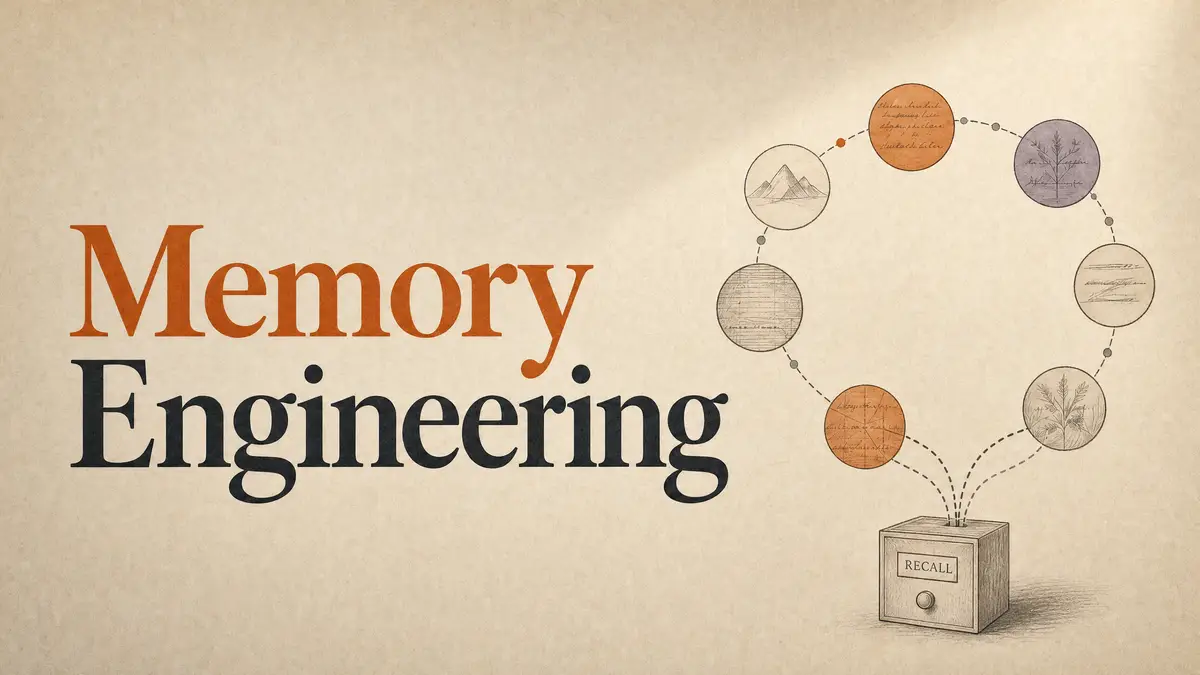
It includes the tools the agent may call, the data it can read, the files it can create and the permissions attached to every action. It also covers state, checkpoints, cost limits, timeouts, human approvals and traces of what happened.
A useful test is to remove the model from your architecture diagram. The components left behind are probably part of the harness.
Example: A CRM Automation Agent
Picture an agent handling new sales enquiries. It reads the contact record, checks the source of the enquiry, identifies the correct pipeline and prepares the next task for the sales team.
The harness decides which CRM fields the agent can view or change. It also records the original value, the proposed change, the time of the action and the rule that permitted it.
High-impact changes can require approval. Deleting a contact, changing ownership or sending a bulk message should not be available simply because the model asked nicely.
What a Business-Ready Harness Should Contain
A practical harness usually needs six parts:
- Context: customer data, business rules, approved knowledge and task instructions.
- Tools: narrow functions for CRM updates, email, calendars, documents and reporting.
- State: durable records of progress, decisions and pending work.
- Controls: permissions, budgets, timeouts, approval gates and allowed actions.
- Safety: isolated execution, secret protection and the minimum access needed for the task.
- Evidence: logs of tool calls, data changes, errors, cost and response time.
More tools are not automatically better. A crowded harness gives the agent more chances to select the wrong function, expose irrelevant data or take an expensive detour.
Start small. Give the agent the minimum environment required to complete one valuable process, then expand from observed demand rather than imagined possibilities.
Layer 2: Loop Engineering Makes the Agent Check Its Work
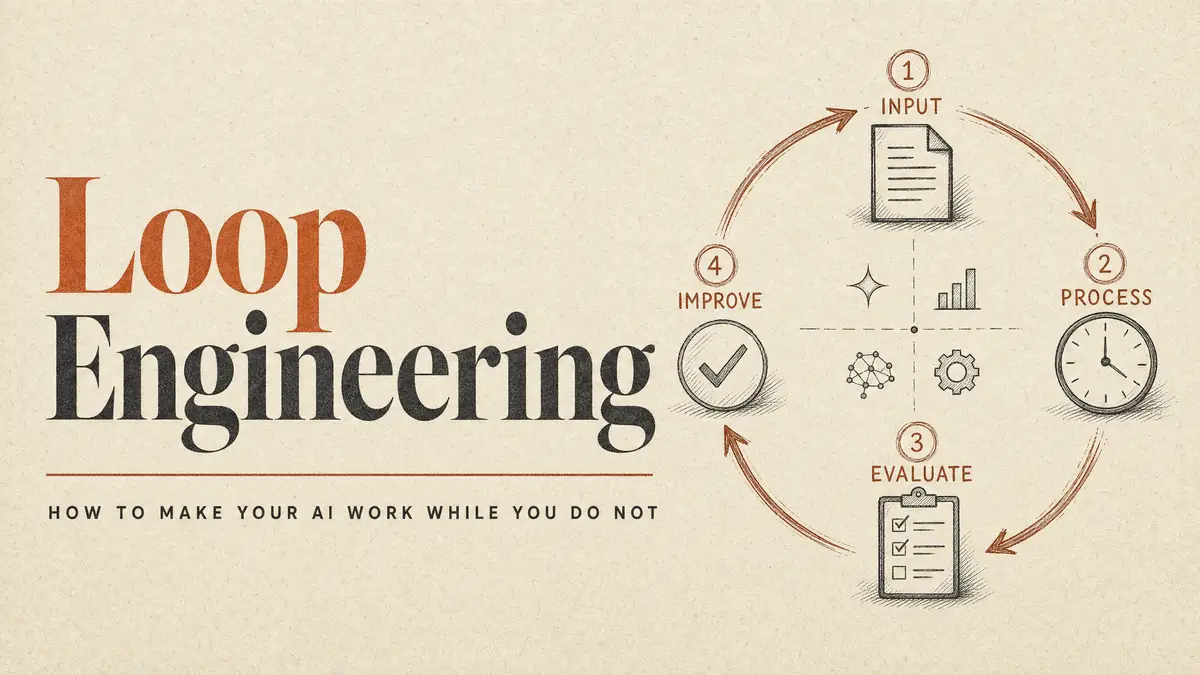
Loop engineering is the fix when the first attempt is close but unreliable. In AI agent systems, it turns a single attempt into a controlled cycle of work, checking, feedback and correction.
The smallest agent loop is model, action, observation and model again. A production loop adds a measurable finish line, evidence of success, a retry limit and an escalation route.
The agent’s confidence does not count as evidence. A valid schema, a matching total, a working link or an independent review does.
Example: A Content Production Agent
A content agent may research a topic, produce a draft and report that the job is complete. That tells you the file exists, not that the article is accurate or suitable for publication.
A proper loop checks the claims against sources, tests every link and compares the writing with the brand rules. If the draft fails, the agent receives a short list of exact corrections rather than the useless instruction to “make it better”.
The loop ends when the checks pass, the retry limit is reached or a person takes over. Without that stopping rule, the agent can rewrite the same paragraph until your API bill develops a personality.
The Seven Parts of a Useful Loop
Every business loop needs a trigger, goal, saved state, action policy, evidence, failure feedback and stopping rule. Miss one and the agent will eventually make the omission visible, usually during a busy week.
For example, a weekly content task may start every Monday at 08:00. Success means one draft with verified links, no unsupported claims and a completed human approval step; failure after two revisions goes to the marketing lead.
Scheduling alone does not create a reliable loop. The proof, correction and exit conditions do the real work.
Layer 3: Graph Engineering Controls the Route
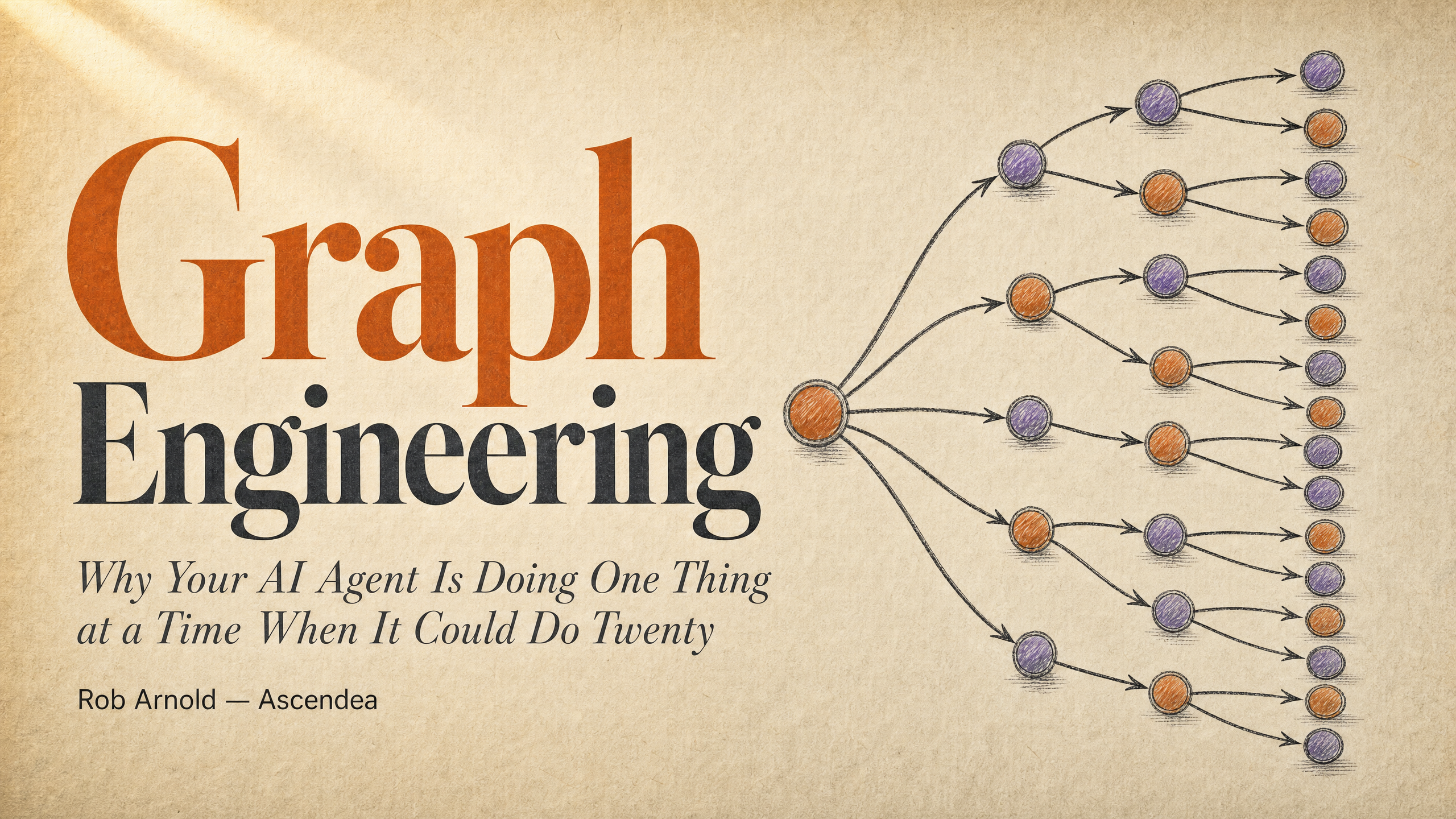
Graph engineering becomes useful when the process has genuine branches, approvals or specialist hand-offs. In complex AI agent systems, it turns hidden control flow into named steps and permitted transitions.
A graph may contain deterministic code, model decisions and human review in the same process. LangGraph, for example, supports long-running stateful agents that combine fixed steps with model-led steps, plus persistence and human intervention.[3]
Not every three-step automation needs a graph. If one agent with two tools can complete the work safely, a visual maze of forty nodes is architecture theatre.
Example: A Lead Follow-Up Agent
A lead follow-up agent might start when a website enquiry reaches the CRM. It checks consent, reads the enquiry and selects one of three approved routes: request missing information, offer a booking link or pass a high-value opportunity to a salesperson.
A reply creates another branch. A booking ends the follow-up sequence, an unsubscribe stops all contact, and a clear buying signal creates a human task with the relevant conversation attached.
The graph makes those routes explicit. It also prevents the agent from inventing a fourth path because the wording of one enquiry was unusual.
When a Graph Earns Its Place
Use a graph when work can split, rejoin, pause for approval, recover from failure or move between specialists. It is also useful when different steps require different permissions or evidence.
Build the graph after observing the real process. Early traces show which paths are stable, where people intervene and which exceptions deserve their own route.
A beautiful diagram built from assumptions is still an expensive assumption. Start with the simplest working harness, study actual runs and formalise only the routes that matter.
How the Three Layers Work Together
Consider an Ascendea-style content production system for a professional services firm. The harness supplies approved sources, web access, brand instructions, file storage, publishing permissions and an audit record.
The graph sets the route: research, draft, fact-check, brand review, human approval and publication. A failed fact-check returns to research, while a failed brand review returns to drafting.
Loops sit inside those steps. Research repeats until the required source coverage is present, and drafting repeats until the checks pass or the retry budget is spent.
The design is nested. The graph runs inside the harness, while selected graph steps contain loops. Each layer has a different job, even though one system contains all three.
Diagnose the Layer Before You Replace the Model
A stronger model cannot repair a broken API, missing permissions or stale customer data. Reliable AI agents also need a sensible stop rule for every retry.
| Symptom | Inspect first | Likely correction |
|---|---|---|
| The agent cannot reach the correct data | Harness | Improve the tool contract, permissions and supplied context |
| Progress disappears between runs | Harness | Add durable state, checkpoints and progress records |
| Outputs are nearly right but inconsistent | Loop | Add objective checks, specific failure feedback and bounded retries |
| The agent keeps working after success | Loop | Define evidence-based completion and budget limits |
| Specialists run in the wrong order | Graph | Define nodes, transitions, joins and approval points |
| Nobody can explain a multi-step failure | Graph and harness | Trace state changes against each named step |
| The process changes every week | Simpler harness | Delay formal graph design until stable routes appear |
This is the commercial value of the framework. You fix the part that owns the failure instead of buying another model and hoping for better manners.
Three Rules for UK SMEs Building AI Agents
First, choose one process with a measurable business result. Lead response, appointment booking and content approval are better starting points than “automate the company”.
Second, define evidence before autonomy. Decide what proves success, which actions need approval and when the agent must stop.
Third, inspect real runs before adding complexity. Logs and exceptions will tell you where a loop or graph is needed far more reliably than a workshop full of sticky notes.
At Ascendea, we build AI agent systems around real sales and marketing processes, not model demonstrations. That means connecting the CRM, defining the controls, testing the failure routes and keeping a person in charge where judgement matters.
Build the System Your Revenue Process Actually Needs
Reliable AI agent systems come from good systems engineering. The harness provides the workplace, the loop provides the proof, and the graph provides the route.
If leads are slipping through gaps between your CRM, inbox and booking tools, adding another chatbot will not fix the underlying process. Ascendea can map one revenue-critical workflow and show you where automation, agent judgement and human approval each belong.
Book an Ascendea demo to discuss your CRM, lead follow-up or content process. Bring the messy version; those are usually the interesting ones.
References and Source Credit
- OpenAI, “A practical guide to building agents”.
- Anthropic, “Building effective agents”, published 19 December 2024.
- LangChain, “LangGraph overview”.