Skip to content
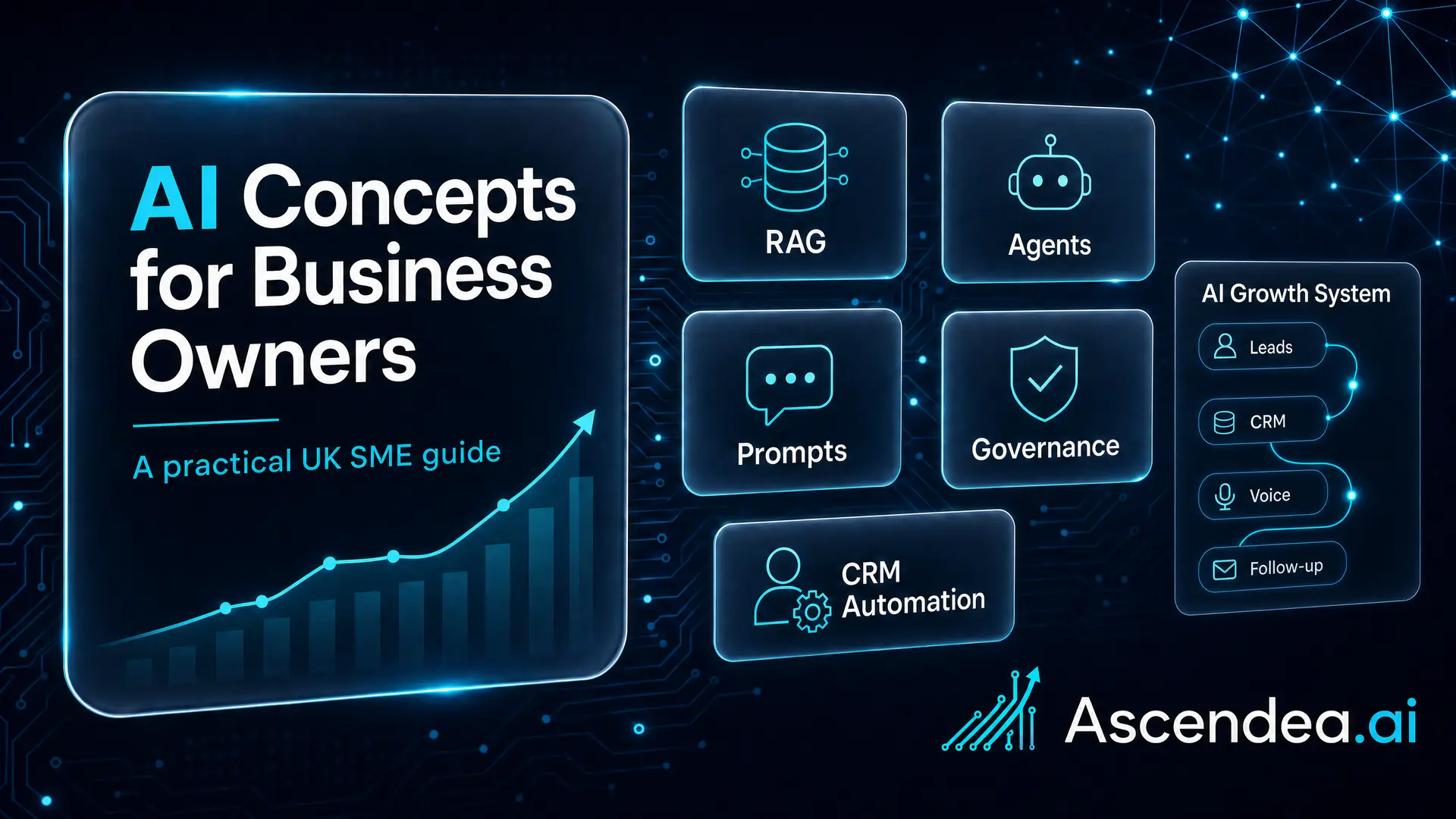
AI Concepts for Business Owners: Practical UK SME Guide
Artificial intelligence has a small branding problem. It keeps arriving in business conversations wearing a name badge full of acronyms: LLMs, RAG, embeddings, tokens, agents, tool calling, memory, evals. It is enough to make a perfectly sensible business owner quietly close the laptop and return to the spreadsheet that has been holding the company together since 2017.
The good news is that you do not need to become a machine learning engineer to use AI well. You do, however, need enough practical AI literacy to ask better questions, choose better systems, brief suppliers properly, and avoid expensive nonsense. In other words, **AI concepts for business owners** are now part of the modern management toolkit. That is why “AI concepts for business owners” should not be treated as a glossary. They should be treated as operating knowledge.
At Ascendea, we look at AI through a simple commercial lens: Does it help the business grow, save time, improve customer experience, reduce risk, or make better decisions? If the answer is no, it may just be jargon in a nice jacket.
Why AI Literacy Matters for UK SMEs
UK SMEs are already experimenting with AI, but the picture is still uneven. The UK Department for Science, Innovation and Technology reported that around **1 in 6 UK businesses** were using at least one AI technology in its AI Adoption Research, while most businesses had no active plans to adopt AI.[1] Other business surveys show higher adoption estimates. The British Chambers of Commerce reported that **35%** of surveyed SMEs were actively using AI in 2025, and YouGov found that **31%** of UK SME decision-makers were using AI tools.[2] [3] These figures are not directly interchangeable because they use different methodologies, so it is worth avoiding a single “definitive” adoption number.
The direction of travel is clearer than the exact percentage: AI adoption is rising, but capability is uneven. That is why **AI concepts for business owners** need to be explained through business outcomes, not vendor brochures. The OECD found that generative AI was in use by the respondent or a colleague in **31%** of surveyed SMEs, yet only **29%** of SMEs using generative AI reported using it in core company activities.[4] That is the gap many business owners can feel. Plenty of firms are dabbling with AI. Far fewer are building it into the workflows where money is made or lost.
That is the Ascendea perspective. AI should not sit in a side tab helping someone write the occasional email. It should support the revenue engine: lead response, follow-up, customer service, appointment booking, quotations, onboarding, reviews, retention, and management insight.
→ Low-Value: “Write me a LinkedIn post.”
→ High-Value (Ascendea): Turn customer questions, case studies, and offers into a consistent content system.
→ Low-Value: “Answer generic FAQs.”
→ High-Value (Ascendea): Use company policies, product data, and escalation rules to support real customers.
→ Low-Value: “Draft a sales email.”
→ High-Value (Ascendea): Trigger follow-ups, qualify leads, update the CRM, and book appointments.
→ Low-Value: “Summarise this document.”
→ High-Value (Ascendea): Extract actions, risks, owners, deadlines, and process improvements.
→ Low-Value: “Give me ideas.”
→ High-Value (Ascendea): Turn CRM, campaign, and service data into practical decisions.
1. Tokens and Context: Why AI Sometimes Forgets What You Said
A **token** is a small unit of text that an AI model processes. It might be a word, part of a word, punctuation, or spacing. This matters because tokens affect cost, speed, and how much information the model can consider at once.
The **context window** is the amount of information the model can hold during a conversation or task. Think of it as the AI’s working desk. If you keep piling papers onto the desk, eventually something important gets buried. When business owners say, “I gave it the instruction earlier, why did it ignore me?”, context is often part of the answer.
The practical move is not to paste the entire company handbook into a chatbot and hope for magic. Use structured inputs. Give the model the relevant policy, the task, the audience, the required format, and the decision you need. For long documents, ask for extraction in stages. AI rewards clarity. It sulks at chaos, politely but still sulks.
2. Prompts: Not Magic Words, but Management Instructions
A **prompt** is an instruction. A weak prompt sounds like, “Write something about our services.” A useful prompt sounds like, “Write a 600-word service page for UK SME owners considering AI voice agents. Use a confident but approachable tone, explain three commercial benefits, address common objections, and end with a consultation call to action.”
Good prompting is really good management. You define the role, task, context, constraints, examples, and success criteria. This is one of the most practical **AI concepts for business owners** because it changes AI from a novelty into a repeatable assistant.
Prompts alone, however, are not an AI strategy, which is why **AI concepts for business owners** must go beyond prompt hacks. If a business depends entirely on clever prompts, results will vary from person to person and week to week. The next level is connecting AI to data, tools, workflows, and evaluation.
3. Embeddings: How AI Finds Meaning, Not Just Keywords
**Embeddings** turn text into numerical representations so systems can compare meaning. OpenAI describes embeddings as a way to measure the relatedness of text strings, commonly used for search, clustering, recommendations, anomaly detection, diversity measurement, and classification.[5]
For a business owner, the plain-English version is this: embeddings allow AI systems to find relevant information even when the wording is different. If a customer asks, “Can I cancel after signing?”, the system may find the cancellation clause even if the document says “termination rights”. That is powerful because real customers rarely use the same language as your internal documents.
This is why document hygiene matters. If your files are named “final-final-v3-new.pdf”, you are not helping the system or the humans. Good titles, clean sections, clear ownership, and current documents make AI search much more useful. AI can be clever, but it should not have to play archaeological detective in your shared drive.
4. RAG: Giving AI Your Company Knowledge
**Retrieval-Augmented Generation**, usually called **RAG**, connects a language model to external knowledge sources such as documents, databases, policies, product information, or support articles. Google Cloud describes RAG as combining retrieval systems with large language models so generated outputs are more accurate, up-to-date, and relevant to specific needs.[6] IBM similarly explains that RAG connects AI models with external knowledge bases to improve relevance and quality.[7]
This is one of the highest-value **AI concepts for business owners** because it explains why a generic chatbot is rarely enough and why company knowledge must be part of the system design. A model trained on broad public data does not automatically know your pricing, policies, service standards, delivery times, stock rules, refund conditions, CRM notes, or tone of voice.
RAG helps an AI assistant answer from your business knowledge rather than from vague internet soup. It is useful for customer support, internal knowledge bases, onboarding, sales enablement, compliance support, and service operations.
RAG is not fairy dust, though. If the documents are outdated, contradictory, or badly structured, the AI can still produce weak answers. Strong RAG needs curated knowledge, sensible chunking, good retrieval, source citations, and ongoing testing.
5. Hallucinations: Confident Answers Are Not the Same as Correct Answers
A **hallucination** is when an AI system presents incorrect or invented information as if it were factual. RAG can reduce this risk by grounding responses in supplied knowledge, but it does not make AI error-proof. IBM notes that RAG can improve trust and reduce hallucination risk, while still depending on the quality of the connected knowledge sources.[7]
For SMEs, the fix is not panic. The fix is process. Decide which tasks are low risk, which need review, and which should never be automated without human approval. A social caption draft is usually low risk. A legal commitment, medical recommendation, financial advice, or binding customer promise is not.
The working rule is simple: **AI can draft, search, summarise, route, recommend, and remind. Humans should own judgement, accountability, and exceptions.**
6. Agents: When AI Moves from Answering to Doing
An “AI agent” is a system that can work towards a goal using tools, workflows, memory, and decision rules. IBM defines AI agents as systems that autonomously perform tasks by designing workflows with available tools.[8] That distinction matters because an agent is not just “a chatbot with better manners”.
A chatbot talks. An agent can act. It might check a diary, qualify a lead, update a CRM, send a follow-up, create a task, retrieve a policy, or escalate a customer to a human. In Ascendea terms, this is where AI starts becoming part of the business growth engine.
→ SME Example: Book qualified sales appointments.
→ SME Example: CRM, calendar, email, SMS, phone, knowledge base.
→ SME Example: Do not quote pricing outside approved ranges.
→ SME Example: Customer preferences, enquiry history, previous objections.
→ SME Example: Complaints, refunds, high-value deals, uncertainty.
The mistake is asking for a general-purpose agent. The better approach is designing a specific agent for a measurable workflow. For example: “Respond to new inbound enquiries within two minutes, qualify the prospect, answer common questions from approved content, book a consultation, update the CRM, and notify the sales team.” Now we have something useful.
7. Tool Calling and APIs: The Plumbing Behind Useful Automation
**Tool calling** is how an AI system uses external systems. An **API** is a structured way for one system to communicate with another. The terminology sounds technical, but the business impact is straightforward: it is the difference between AI saying, “You should book a meeting,” and AI actually checking availability and booking it.
For Ascendea clients, this is where AI connects to CRM, calendars, forms, email, SMS, voice agents, payment systems, dashboards, and support platforms. Without tool access, AI is often just a very articulate intern. With the right tools and permissions, it becomes an operational assistant.
Permissions matter. You would not give a new team member unrestricted access to your bank account, customer database, and email system on day one. AI deserves the same grown-up controls.
8. Memory: Useful Personalisation, Not Uncontrolled Surveillance
**Memory** allows an AI system to use past interactions or stored context to improve future responses. In business, memory can be helpful when it remembers customer preferences, previous enquiries, account status, service history, or internal working style.
The danger is storing too much, too casually. UK SMEs should think carefully about privacy, consent, retention, and access control. Memory should support a better customer experience, not become a digital loft full of forgotten boxes and GDPR anxiety.
Good AI memory is intentional. It remembers what improves service and forgets what creates risk.
9. Evaluations: How You Know Whether AI Is Actually Working
**Evaluations**, often called evals, are tests that measure AI performance. Google Cloud notes that model evaluation can score generated text and retrieved chunks against metrics such as coherence, fluency, groundedness, safety, instruction-following, and question-answering quality.[6]
For business owners, evaluations answer practical questions. Did the AI answer from the right document? Did it follow the escalation rule? Did it invent a policy? Did it book the appointment correctly? Did it save time without creating rework?
This is another vital **AI concept for business owners** because it stops AI becoming a faith-based initiative. If you cannot measure reliability, speed, conversion, satisfaction, or error rates, you are guessing.
10. Governance: Boring Until It Saves Your Backside
**AI governance** sounds dull, but so do seatbelts until the moment you need one. NIST says its AI Risk Management Framework is intended to help organisations incorporate trustworthiness considerations into the design, development, use, and evaluation of AI systems.[9]
For SMEs, governance does not need to become a 90-page policy that nobody reads. It needs a practical operating model: approved tools, data rules, review points, customer disclosure where appropriate, human escalation, supplier checks, and a register of AI use cases.
The best governance is lightweight, visible, and connected to daily work. It should help teams move faster safely, not slow everything down with theatre.
From Concepts to Commercial Advantage
The real value of **AI concepts for business owners** is not knowing the vocabulary. The real value of **AI concepts for business owners** is knowing what to build next. If you understand tokens and context, you design better inputs. If you understand embeddings and RAG, you build better knowledge systems. If you understand agents and tools, you automate real workflows. If you understand evaluation and governance, you scale without losing control.
→ Question: Where are we losing time, leads, or consistency?
→ Output: One measurable use case.
→ Question: What must the AI know to perform safely?
→ Output: Approved documents, FAQs, policies, CRM fields.
→ Question: What can it do, and when must it escalate?
→ Output: Clear boundaries and human review points.
→ Question: Which systems must it use?
→ Output: CRM, calendar, email, voice, SMS, forms.
→ Question: How will we know it worked?
→ Output: Response time, conversion, error rate, customer satisfaction, staff time saved.
The Ascendea Perspective
At Ascendea, we believe AI should be practical, measurable, and commercially useful. For UK SMEs, the opportunity is not to chase every shiny model release. The opportunity is to design AI-powered growth systems that respond faster, follow up better, serve customers more consistently, and give leaders clearer insight.
That might mean an **AI voice agent** that answers missed calls and books appointments. It might mean a CRM-connected assistant that follows up every enquiry properly. It might mean a RAG-powered knowledge base for your team. It might mean automated review requests, reactivation campaigns, sales qualification, or smarter onboarding.
The technology matters, but the workflow matters more. A poor process with AI bolted on is still a poor process. It is just wearing futuristic trainers.
Final Thought
If you are a UK SME owner, you do not need to learn AI like a dictionary. You need **AI concepts for business owners** translated into commercial action. You need to understand the handful of concepts that affect business outcomes. Start there, then build one useful workflow at a time.
And if you would rather not translate the jargon alone, that is exactly where Ascendea comes in.
Ascendea helps SMEs turn AI concepts into working growth systems: CRM automation, AI voice agents, lead follow-up, customer journeys, and practical AI implementation. If you are ready to move from AI curiosity to AI capability, book a conversation with Ascendea and let’s build something that earns its keep.
References
[1]: https://www.gov.uk/government/publications/ai-adoption-research/ai-adoption-research “Department for Science, Innovation & Technology, AI Adoption Research”
[2]: https://www.britishchambers.org.uk/news/2025/09/turning-point-as-more-smes-unlock-ai/ “British Chambers of Commerce, Turning Point As More SMEs Unlock AI”
[3]: https://yougov.com/en-gb/articles/52730-we-polled-uk-sme-leaders-about-ai-adoption-heres-what-they-said “YouGov, We polled UK SME leaders about AI adoption”
[4]: https://www.oecd.org/en/publications/generative-ai-and-the-sme-workforce_2d08b99d-en/full-report/component-4.html “OECD, Generative AI and the SME Workforce”
[5]: https://developers.openai.com/api/docs/guides/embeddings “OpenAI, Vector embeddings”
[6]: https://cloud.google.com/use-cases/retrieval-augmented-generation “Google Cloud, What is Retrieval-Augmented Generation”
[7]: https://www.ibm.com/think/topics/retrieval-augmented-generation “IBM, What is retrieval augmented generation”
[8]: https://www.ibm.com/think/topics/ai-agents “IBM, What are AI agents”
[9]: https://www.nist.gov/itl/ai-risk-management-framework “NIST, AI Risk Management Framework”